Chemical
Activity
- Development and operation of the YAKUMO chemical substance management support system
- YAKUMO registration support
- Risk Assessments
- Appropriate management of poisonous and deleterious substances
- Posted Notices on Handling Precautions for Hazardous Substances
- Matters related to work environment measurement
- Disposal of chemical substances
- Monitoring of drainage(drainage quality measurement)
Development and operation of the YAKUMO chemical substance management support system
Implementation of the Chemical Management Support System
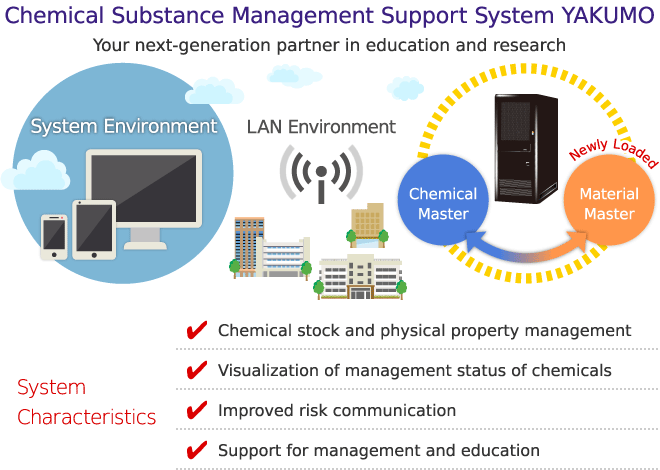
In November 2006, Kumamoto University implemented the “YAKUMO” Chemical management support system as a tool for efficiently conducting chemical management. YAKUMO is a system that enables tasks such as management, stocking, and calculating of chemicals to be performed more efficiently by registering the names and volumes of chemicals when they are obtained or used. Moreover, Kumamoto University promotes efficient management of chemical substances by migrating this chemical registration information to the “BUPPIN-SEIKYU” management system and by introducing an experimental liquid waste collection system.
Development of the Chemical Management Support System
In June 2015, Kumamoto University finished developing the YAKUMO Chemical Substance Management Support System, which was designed to meet the university's current needs for more efficient chemical management. Kumamoto University determined the functional specifications of the system. At the same time, the programing was entrusted to a local company to facilitate communication with the development team and ensure more flexible and agile handling. The development concept was to provide a “chemical management system that was essential to university’s researchers”. Barcode Sticker were ingeniously modified so that all laboratory members could see the usage status of chemicals and know if they were hazardous or toxic. Furthermore, YAKUMO was designed to support the export of Chemical Substance Data Sheet.
YAKUMO registration support
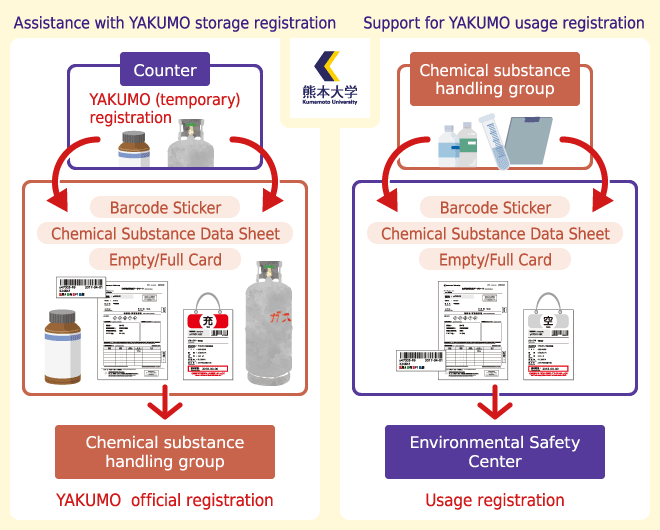
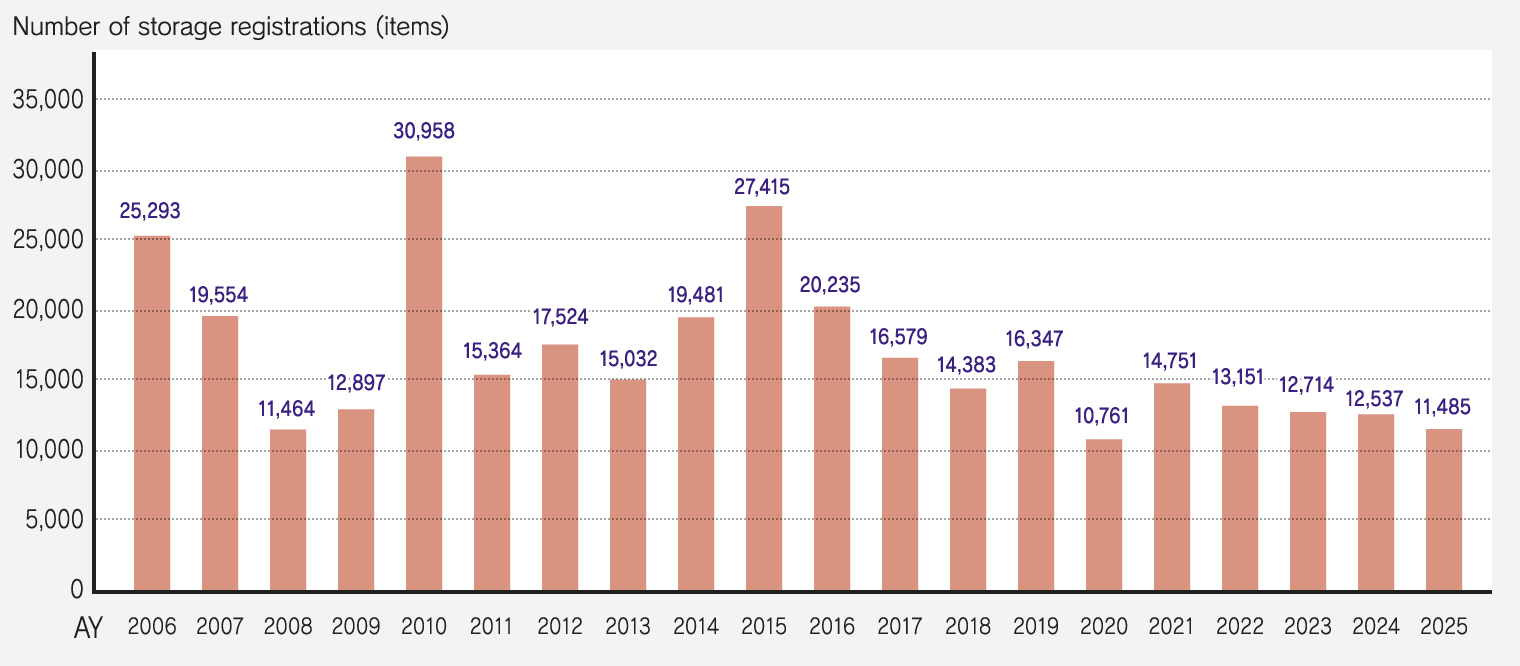
Kumamoto University provides support for YAKUMO registration when chemicals or high-pressure gases are obtained to reduce the workload of the chemical substance handling group and improve the YAKUMO registration rate. This support is made possible through the cooperation of our chemical and high-pressure gas suppliers.
Increasing the YAKUMO registration rate will improve the accuracy of Kumamoto University's hazard map for chemical substances.
Click the image to view a larger size.
Risk Assessments
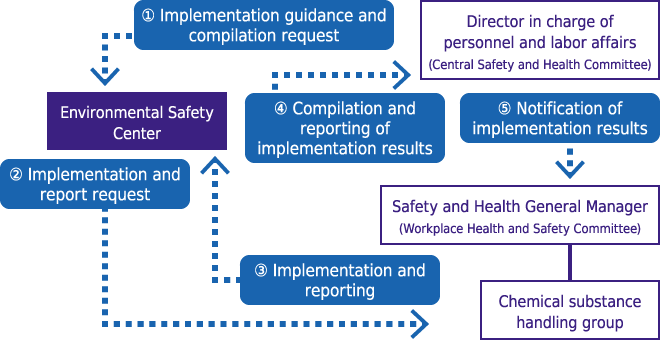
Risk assessment involves assessing the hazard risks of chemical substances before using them, and then informing group members and recording the results.
At Kumamoto University, the Central Safety and Health Committee decides on the implementation policy, and the Environmental Safety Center provides guidance and coordinates the implementation.
Kumamoto University conducts risk assessments every year, considering the mobility of group members (especially students).
In addition, Kumamoto University can use YAKUMO to support the implementation of risk assessment.
Appropriate management of poisonous and deleterious substances
Poisonous and Deleterious Substances (Poisonous and Deleterious Materials) are chemical substances that could be used in terrorism and crime and thus must be strictly controlled.
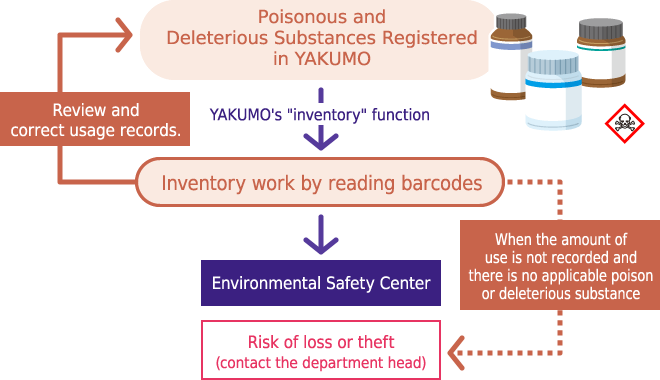
For this reason, Kumamoto University uses YAKUMO's inventory function to read barcodes and check whether poisonous and deleterious materials are stored correctly. The Environmental Safety Center compiles the inventory of poisonous and deleterious substances.
Poisonous and deleterious materials are also recorded by weight (or volume) each
time they are used. We also check the Poisonous and Deleterious Materials Usage
Register in the Chemical Substance Data Sheet output from YAKUMO to ensure that
the remaining quantity is appropriate.
The following forms are available for chemical substances for which there are
not enough columns in the record or which are not subject to YAKUMO
registration.
Posted Notices on Handling Precautions for Hazardous Substances
Under Japanese safety regulations (the Ordinance on Prevention of Organic Solvent Poisoning and the Ordinance on Prevention of Hazards due to Specified Chemical Substances), laboratories handling these substances are legally required to post specific handling precautions in the workplace. These chemicals pose significant risks, including health hazards, fire, explosion, and environmental contamination. Please use these materials to ensure a safe working environment and to mitigate daily operational risks.
How to Use These Materials
This collection covers all organic solvents and specified chemical substances required by law.
-
- Individual Posting:
- You can download the data and selectively print/post only the information for the specific chemicals currently in use in your lab.
-
- Booklets for Consolidated Posting:
- The Environmental Safety Center provides booklets that compile precautions for all regulated substances. For laboratories that use a wide variety of chemicals, this booklet is intended to serve as a single, consolidated resource to prevent walls from becoming cluttered with individual notices. By posting the booklet itself, you can manage all necessary information efficiently. If you require a booklet, please contact us.
Disclaimer
The information provided is based on guidelines from the Ministry of Health, Labour and Welfare and manufacturers’ websites, assuming typical university-level handling. However, these materials do not guarantee safety under all possible experimental conditions. Please review the content in light of your specific procedures and ensure appropriate safety measures are in place.
Click the image to download the file.
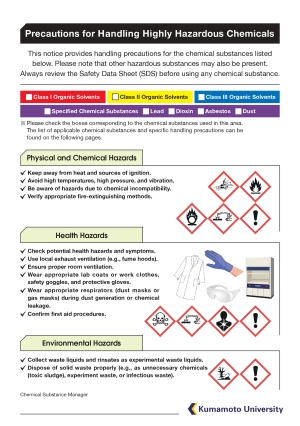
Cover [PDF 731KB]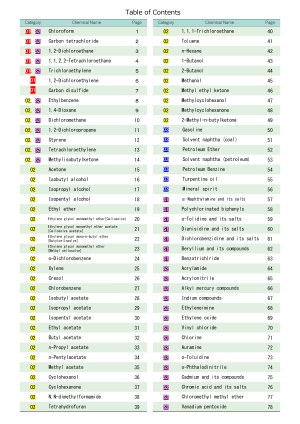
Table of Contents [PPT 60KB]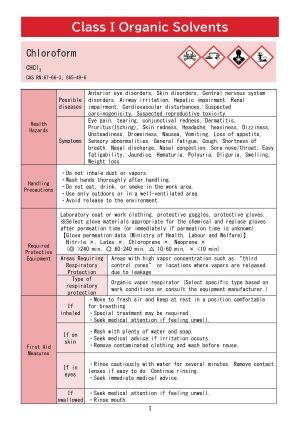
Precautions [PPT 1.3MB]
Matters related to work environment measurement
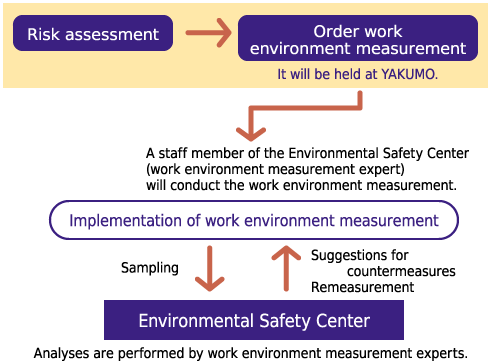
The Occupational Health and Safety Law stipulates the "Working Environment Measurement Law, the purpose of which is to help maintain the health of workers by ensuring an appropriate working environment.
Specific chemical substances are subject to working environment measurements. Hence, when conducting experiments (work) using these substances, it is necessary to perform measurements in the working environment. These are chemical substances that can potentially cause health problems. The performed measurements are used to determine how much these chemical substances can affect workers or working environments based on their degree of dispersion.
Kumamoto University conducts working environment measurements independently and uses YAKUMO to select workplaces (laboratories, etc.) for working environment measurements after risk assessment.
The Environmental Safety Center is equipped with analytical instruments for measuring working environments, and is staffed by technical personnel certified as working environment measurement experts. Therefore, if the results of the working environment measurement are bad, we can immediately check the situation, take countermeasures, and then re-measure to confirm improvements.
Disposal of chemical substances
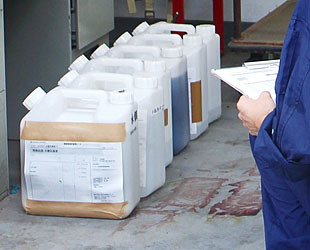 Waste or surplus chemical substances at Kumamoto University must be disposed of
in compliance with relevant laws, regulations, and Environmental Safety Center
instructions.
Waste or surplus chemical substances at Kumamoto University must be disposed of
in compliance with relevant laws, regulations, and Environmental Safety Center
instructions.
Chemical substances are disposed of if they meet the following categories: experimental liquid waste, unnecessary chemicals, experiment waste, toxic sludge, and instruments containing mercury. For more information on the disposal of chemical substances, please see the relevant page on that topic.
Monitoring of drainage(drainage quality measurement)
Drainage quality measurement for sewerage discharge water
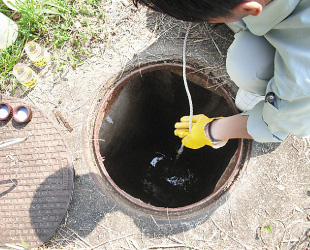 Based on the Sewerage Law, we measure the quality of liquid drainage into the
sewerage system managed by Kumamoto City in consultation with city
officials.
Based on the Sewerage Law, we measure the quality of liquid drainage into the
sewerage system managed by Kumamoto City in consultation with city
officials.
The Environmental Safety Center compiles effluent drainage quality measurement
results, and water sampling and analysis are outsourced to an external
contractor. If the results show any behavior that could exceed the effluent
standards, we will provide guidance to the department discharging the water.
Water sampling points for sewerage
discharge water
Drainage quality measurement in storage tanks (pH only)
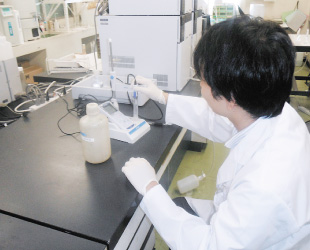 In Kumamoto University, we have a storage tank upstream of the sewage discharge
point equipped with a system that stops pumping if the pH of the drainage shows
abnormal values. (However, some areas are not pumped.)
In Kumamoto University, we have a storage tank upstream of the sewage discharge
point equipped with a system that stops pumping if the pH of the drainage shows
abnormal values. (However, some areas are not pumped.)
Drainage quality measurement in the storage tanks is performed once a month by
taking water samples and having only the pH measured at the Environmental Safety
Center. If the result is likely to exceed the effluent standard of the Sewerage
Law (pH 5.0 to pH 9.0), we will provide guidance to the department that is
discharging the water.
Water sampling points in storage tanks
